


Welcome to the August Metro Vancouver real estate market update. Sales volumes remain low, but they are showing signs of improvement, likely because sellers are becoming more willing to lower their prices. Some observers point to the 10%+ increase in sales year over year for detached homes and townhomes as evidence of a possible turnaround. While this is true, it’s important to note that sales are still 19.2% below the 10-year average, compared with only 13.9% below in July. Adding to the mixed picture, there were 2,286 sales in July, compared to just 1,904 in August.
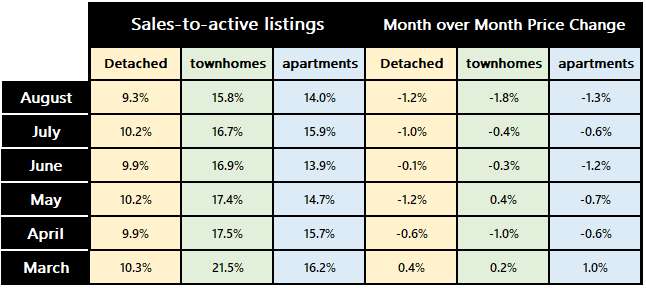
What is certain is that prices fell last month. As shown in the table below, all housing segments declined by more than 1% month over month, with townhomes dropping close to 2%. This represents the steepest monthly decline in over a year. One likely explanation is that sellers, eager to finalize their living arrangements before the school year, lowered prices to secure the sales.
The sales-to-active listings ratio also fell across all housing categories, signaling weaker demand. This ratio measures the balance between supply and demand in the real estate market: the higher the ratio, the stronger the demand. A sustained reading below 12% is considered weak and often results in downward pressure on prices. Changes in the direction of this ratio can also be predictive of future price trends, and the recent price declines likely reflect the reduced demand.
Looking ahead, the Bank of Canada and the U.S. Federal Reserve will meet in mid-September to decide on their respective interest rates. Current polls suggest Canada has roughly a 70% chance of cutting rates, while the odds of a Fed cut are closer to 90%. I don’t expect these meetings to produce a major shift in real estate activity.
Perhaps more impactful news comes from the Supreme Court of British Columbia’s recent ruling that the Cowichan First Nation, along with several allied First Nations, holds rights to a parcel of land in Richmond almost twice the size of Stanley Park. This area currently includes commercial properties, residential properties, and a federally operated port. If the ruling withstands legal challenges, it could dampen foreign investment—not only in residential real estate but in commercial property as well, which is not currently subject to restrictions. The issues and reasoning behind this decision are complex, but you can find a good introduction by clicking the image below.
This ruling is also timely, as September 30 marks the National Day for Truth and Reconciliation—a reminder that gives us much to reflect on.
Enjoy the rest of the month.